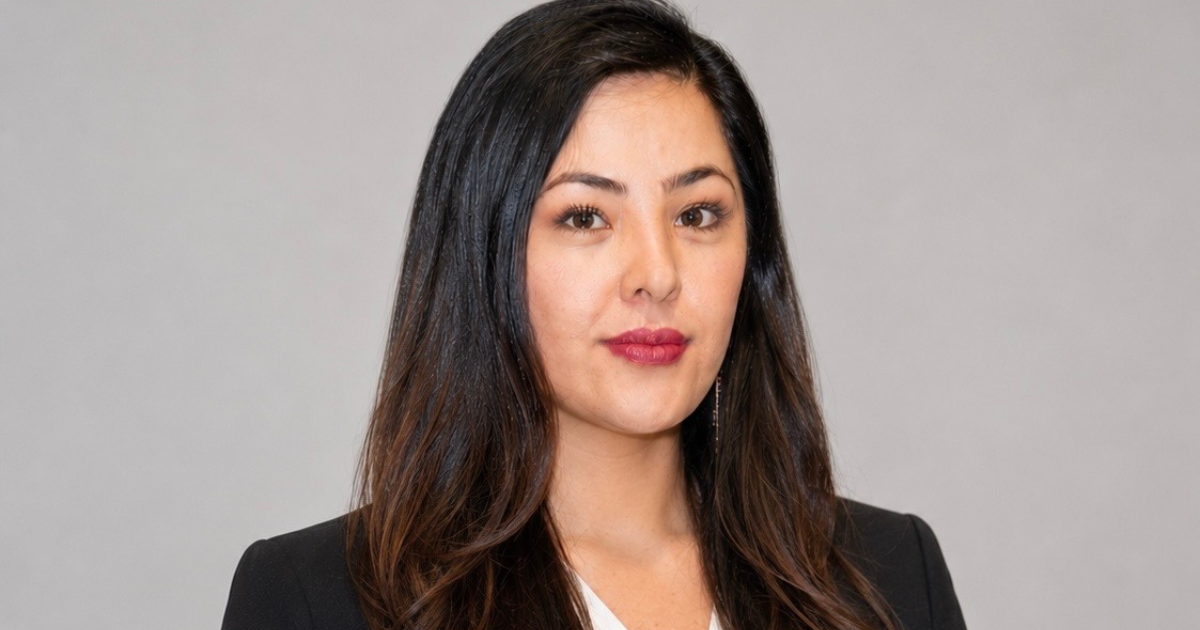
Nilofar Moradi fled Afghanistan with her life and her conviction intact. Now, from exile in Canada, she is doing what she has always done: making sure Afghan women and girls are not forgotten.
She was a journalist in Afghanistan. She reported on women’s rights, on justice, on the lives of people her government would rather the world did not see. And when the Taliban returned to power in August 2021, that work made her a target.
Nilofar Moradi left Afghanistan because she had no choice.
She arrived in Canada carrying something that could not be confiscated at any border: more than a decade of experience as a journalist, a human rights advocate, and a women’s rights activist. A law degree. A political science education. And a belief, which nothing has managed to dislodge, that the stories of Afghan women matter and that the world must be made to hear them.
“In a time when the system of gender apartheid imposed on women and girls in Afghanistan has denied millions of girls access to education and opportunity,” she says, “even the smallest opportunity can become a source of hope and transformation.”
Today, Nilofar is one of the Advisory Members of the Afghan Girls Initiative, a program launched by Hear Her Stories that connects Afghan women living abroad with girls still inside Afghanistan. One private conversation a week. Eight weeks. The kind of mentorship that does not require a classroom or a curriculum, only two people willing to show up for each other across one of the world’s most heavily enforced silences.
From Kabul to Canada
Nilofar’s story is not unusual among Afghan women who built careers, lives, and identities during the twenty years between the Taliban’s first and second reigns. What is unusual is what she did next.
She is one of four Afghan women featured in the documentary An Unfinished Journey, which follows their lives in exile after 2021, tracing how they continue to advocate, to rebuild, to refuse the ending that the Taliban tried to write for them. The film is not about loss, though there is loss everywhere in it. It is about continuation. The insistence on continuing.
“These narratives are essential for protecting the truth,” Nilofar says. “Preserving the stories of Afghan women and girls is not just about memory. It is about evidence. It is about advocacy. It is about making sure the world cannot claim it did not know.”
This is the thread that runs through everything she does. Documentation as resistance. Storytelling as survival.
Why She Joined the Afghan Girls Initiative
When Nilofar first heard about the Afghan Girls Initiative, something in it matched what she had been thinking for years.
The program began with a survey. Hear Her Stories asked 219 Afghan girls what they needed. The girls answered in extraordinary detail: English, coding, journalism, graphic design, business, public speaking, AI. They were not vague. They were not passive. They were planning, precisely, for futures that the Taliban had declared illegal.
One in four said the same thing: they did not know where to start.
That answer, Nilofar says, is the one that cannot be addressed by a policy paper or a UN resolution. It requires a human being. Someone who has already taken the first step and can describe what it felt like.
“Every mentoring relationship, every investment in a girl’s potential, can help shape a stronger future for Afghan girls and for Afghanistan itself,” she says. “Afghan girls do not simply need support. They need to be seen as the future leaders, thinkers, and builders that they already are.”
As an Advisory Member, Nilofar brings her legal and human rights expertise, her deep understanding of the Afghan women’s rights landscape, and something harder to quantify but perhaps more important: the knowledge of what it means to have once had a future and to have had it taken away, and to have chosen, despite everything, to keep building.
What Documentation Means
One of Nilofar’s most significant contributions to the Afghan Girls Initiative is her insistence on the importance of outcome documentation.
After each cohort of the mentorship program, Hear Her Stories will document the stories of the girls and mentors involved, anonymously where safety requires it. What changed. What was faced. What the daily reality of being a girl in Afghanistan under Taliban rule actually looks like, from the inside.
This documentation is not incidental to the program. For Nilofar, it is central to its purpose.
“The international community needs to understand what gender apartheid looks like in practice, not in theory,” she says. “It looks like a girl who was accepted to university and is now sitting at home with no direction. It looks like a young woman who knows exactly what she wants to study and is not allowed to leave the house to do it. It looks like talent and ambition and determination being systematically, deliberately destroyed. That needs to be named. That needs to be recorded. That needs to be heard.”
An Unfinished Journey
The title of the documentary she appears in is not metaphorical.
For Nilofar Moradi, and for the girls inside Afghanistan whose voices the Afghan Girls Initiative is working to amplify, the journey is genuinely, urgently unfinished. The schools are closed. The universities are closed. The futures are on hold.
But hope, she insists, is not.
“I joined this initiative because I believe that even in the darkest circumstances, a connection between two women, one who has found her way and one who is still looking for hers, can be a light. It is not everything. But it is real. And right now, real is what matters.”
Nilofar Moradi is an Afghan journalist, human rights advocate, and women’s rights activist based in Ottawa, Canada. She holds a degree in Law and Political Science and has more than a decade of experience advancing women’s rights, social justice, and public awareness of issues affecting Afghanistan. She is an Advisory Member of the Afghan Girls Initiative, a program by Hear Her Stories connecting Afghan women abroad with girls still inside Afghanistan.
To learn more about the Afghan Girls Initiative, read the full article here and apply directly to the program here.