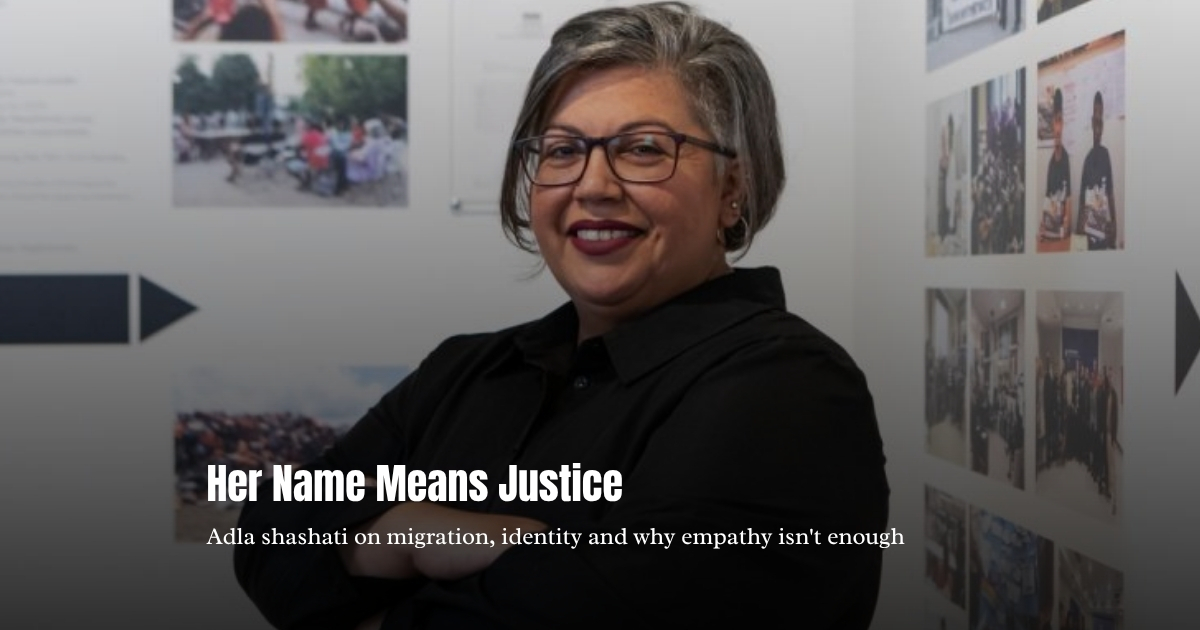
Adla Shashati has spent her life bridging two worlds. On World Refugee Day, she asks us to leave empathy behind and start acting.
Her name was not an accident. In Arabic, Adla means justice. Growing up in Athens, the daughter of a Sudanese father and a Greek mother, she was asked about it constantly. It was not a common name. People wanted to know what it meant. And every time she explained it, she felt the weight of it settle a little more firmly onto her shoulders.
“It was like handing me a baton,” she says. “Saying that you have to be just. That if you can help someone, you should do that.”
Adla Shashati did not plan to become an activist. She planned to be a journalist, to report things, to take interviews, to write down what was happening and let the facts speak. But the facts she kept encountering were the same ones, told by the same people, over and over again: the migrants and refugees who surrounded her, who she considered family, who were excluded from the very stories being told about them.
“The majority of people who were reading or seeing or listening,” she says, “my people, people who I consider to be family, were excluded.”
That gap became her life’s work.
Today, Adla is the Director of the Greek Forum of Migrants, one of the most prominent migrant-led organisations in Europe. She is a journalist, an activist, and one of the clearest voices on the continent on the intersection of migration, racial justice, and women’s rights. And on this World Refugee Day, she has a message she wants delivered plainly.
Leave empathy aside. Take action.
The System Was Not Built for Them
Greece sits at the edge of Europe, and for more than a decade it has been one of the primary entry points for people fleeing conflict, poverty, and persecution, crossing the Aegean Sea from Turkey, or the Evros river from the land border. The crossings are dangerous. The boats are overcrowded. People have drowned. Thousands of them.
“At the seas of the Mediterranean, at the seas of the Aegean, we have people who have lost their lives,” Adla says. “Thousands of people who have lost their lives, while trying to flee war, conflict, and pain, and go somewhere better.”
What waits for the ones who make it is not refuge. It is a system designed, she says, for processing and not for people.
“They are treated mostly as beneficiaries. Not as human beings. And I think that this is the main problem.”
When a woman arrives in Greece today, often having survived violence, trafficking, the loss of family members on the journey, her first week is defined by one word: insecurity. She cannot understand the language. There is rarely a proper interpretation. The processes she must navigate are opaque and unending. And even years later, that insecurity does not fully leave.
“Even if you are in Greece for five or six or seven years, you still have this type of insecurity,” Adla says. “Because the information that is available is not always the correct information.”
Not All Refugees Are Equal
There is something Adla has been saying for years that Europe proved, loudly, in 2022.
When millions of Ukrainians fled the Russian invasion, they were welcomed with a speed and generosity that stunned advocates who had spent decades watching a different system operate. Temporary protection was issued almost immediately. Children went to school. Benefits were available within days.
“On the other hand, we had people who were coming from Syria, from Afghanistan, from Congo, from Sudan, from Palestine,” Adla says. “These people, in order to ask for asylum and receive it, they had to wait more than six months. Which meant they were six months in a camp, in the borders of Greece.”
She does not say this to diminish what Ukrainians experienced. She says it because the contrast revealed something that advocates had known but that European governments had never been forced to confront so visibly: race determines visibility. Race determines acceptance. Race determines access.
“If we want to talk about inclusion, race, especially colour, is very distinctive,” she says. “It plays a very significant role in how the process is going to be for people who are migrating.”
Women from African backgrounds, she explains, often face both racism and sexism simultaneously. They are doubly invisible. Doubly unrecognised. And doubly excluded from the resources and support that would help them rebuild.
Integration Is the Wrong Word
Ask Adla what integration means for a woman who has lost everything, and she pauses.
Then she tells you she does not use that word.
“A colleague of mine once said, integration is like changing your skin,” she says. “It’s becoming someone else. It’s not being who you are and feeling included in a specific society. It’s like you are changing, but the society remains unchanged.”
The word she prefers is participation. A two-way process. One in which a woman can contribute her talents, her culture, her knowledge, her experience, and be recognised for them. One in which difference is not something to be erased but something to be valued.
“Difference, for me, is always something good,” she says simply.
The Afghan Girl Who Walked for Hours
Around five or six years ago, Adla met a young Afghan woman in a camp outside Athens. She had arrived alone. She was frightened. She wanted to learn Greek.
Adla told her about organisations offering language lessons. She told her that the Greek Forum of Migrants had volunteer teachers, that the lessons were free, that they ran in the afternoon so it would be easier for her to come.
The young woman came every day. The camp was outside the city. There was not always a bus. Sometimes she walked for hours. Sometimes she stayed at a friend’s place. Once, she slept in the office.
She earned her language qualification. She became a translator at an NGO. Then she began helping other refugee women, informally at first, building something of her own.
“If I am proud of something,” Adla says quietly, “it’s giving this information to this person. Because I think I helped a bit in that.”
It is the smallest version of the story she is trying to tell on the largest possible stage.
The Political Shift
Europe is moving in a direction that keeps Adla up at night.
Far-right governments are gaining ground across the continent. In Greece, in recent weeks, she has watched the consequences become visible and violent. Assaults against the Filipino community. Attacks against other migrant community members. Attacks against the LGBTQI+ community. Fascist slogans and Nazi salutes in the north of the country. Hate speech online, including beneath posts published by her own organisation.
“Far-right rhetoric can normalise discrimination,” she says. “Which means that societies feel that it is okay to act with hate, and that it is okay to have violence.”
And yet. She will not let the story end there.
“We shouldn’t underestimate the strength of our communities,” she says. “These women, who have faced displacement, who have faced loss, who have faced trauma, yet still choose to support others. They are always there. They are always helping. They are trying the best they can, even though they are directly affected by this political shift.”
This is what she means when she talks about hope. Not optimism. Not the belief that things will get better because they should. Something more hard-won than that.
“Hope is choosing to continue, even though things are not whatever you thought they should be,” she says. “It’s like when you fall, you need to get up. As many times as you fall, you need to get up. Because otherwise, change is not possible.”
What She Wants You to Do
World Refugee Day happens every year. Speeches are made. Candles are lit. And the next day, the pushbacks continue, the camps remain, the policies do not change.
Adla Shashati knows this. She has lived it for decades.
So we asked her directly: what do you actually want people to do after listening to this conversation?
“I want people to move beyond the empathy part,” she says. “Beyond feeling that, okay, I’m a philanthropist and I have to do something, I heard a very nice story, and move from that into action.”
Listen to migrant voices directly. Support organisations led by refugees and migrants. Challenge misinformation every time, without letting it pass. Vote for policies that protect human rights. Create opportunities in your workplace, your school, your community.
And most importantly: recognise migrants and refugees for who they are.
“They are human beings. They have ideas. They have skills. And they have dreams.”
Her name means justice. She has been passing the baton her whole life.
Now she is passing it to us.
Adla Shashati is the Director of the Greek Forum of Migrants and a journalist based in Athens, Greece. This conversation was recorded on June 15, 2026, for the Voices of Impact series by Hear Her Stories in partnership with the Journalists and Writers Foundation. The series launches on World Refugee Day, June 20, 2026.
Hear Her Stories amplifies the voices of women and girls globally through storytelling, campaigns, and community programs. Follow us at @hearherstories.